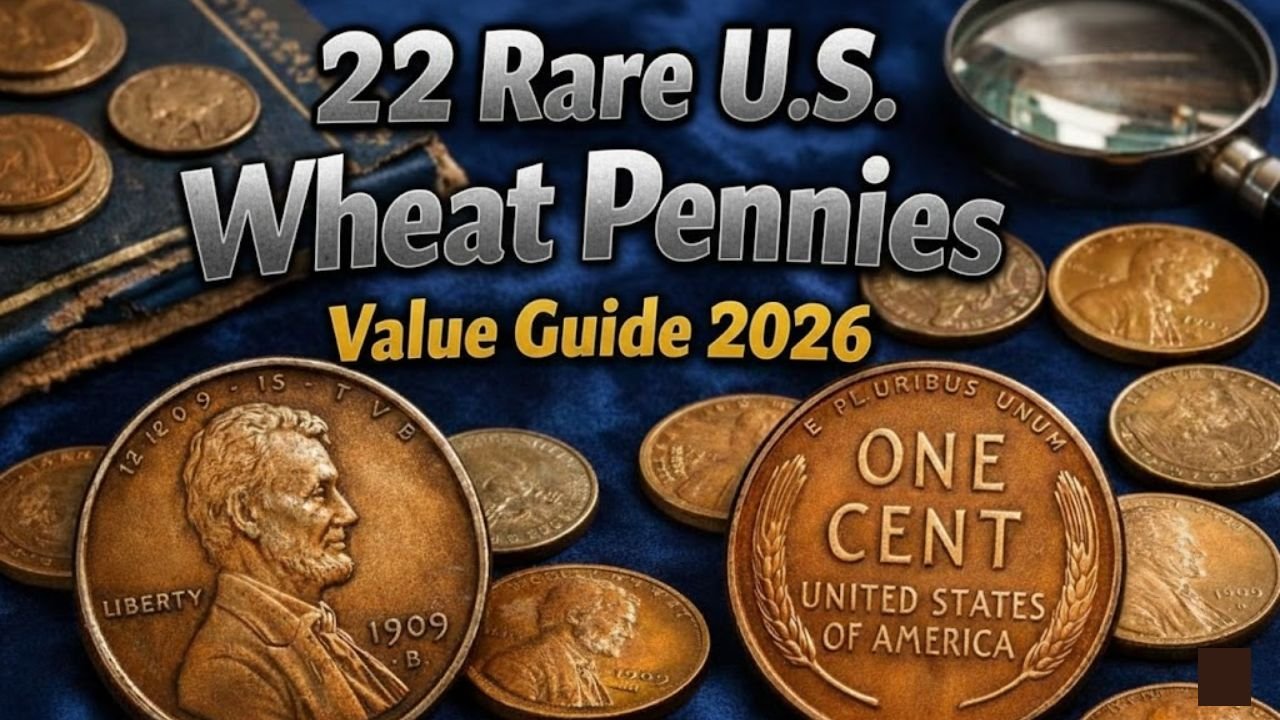
22 Rare Wheat Pennies Value Guide 2026: Have you ever looked closely at an old penny? That copper coin with wheat stalks on the back might be worth way more than one cent. Some are selling for thousands—even millions—of dollars right now. The Lincoln Wheat Penny was made from 1909 to 1958. That’s almost 50 years of history you can hold in your hand. These coins witnessed World War I, the Great Depression, and World War II. Today, collectors are hunting for them like treasure. And the best part? You might have one sitting in an old jar at home right now.
Why Everyone Loves These Old Pennies
When the Wheat Penny first appeared in 1909, it was a big deal. For the first time ever, a U.S. coin showed a real person—Abraham Lincoln. Before that, coins just had made-up figures like Lady Liberty. The designer, Victor David Brenner, created something special. The front has Lincoln’s portrait. The back shows two wheat stalks, which represented America’s farming strength back then. These pennies passed through millions of hands for nearly fifty years. They bought candy, paid for newspapers, and survived wars and hard times. In 1959, the design changed to the Lincoln Memorial we see today. But those wheat-back pennies? They became instant classics.
Lincoln Wheat Penny Fast Facts
Here’s everything you need to know about these coins at a glance:
| Category | Details |
|---|---|
| Years Made | 1909 to 1958 |
| Designer | Victor David Brenner |
| What It’s Made Of | 1909-1942, 1944-1958: 95% copper, 5% tin/zinc |
| 1943 only: Zinc-coated steel (looks silver!) | |
| Weight | 3.11 grams (copper) / 2.7 grams (steel) |
| Size | 19 mm across (same as today’s penny) |
| Mint Marks | No mark = Philadelphia, D = Denver, S = San Francisco |
| Super Rare Ones | 1909-S VDB, 1914-D, 1922 “No D,” 1931-S, 1955 Doubled Die |
| What Makes Them Valuable | How many were made, condition, mint mark, errors, certified grading |
| Where to Find Them | Estate sales, coin shops, online auctions, grandma’s attic, bank rolls |
What Makes a Wheat Penny Worth Big Money?
Not every old penny is valuable. Here’s what collectors actually pay for:
- How many were made. Coins with low mintage numbers are harder to find. The Denver (D) and San Francisco (S) mints usually made fewer than Philadelphia.
- Condition matters—a lot. A shiny, barely-used penny can be worth 100 times more than a beat-up one. Collectors love coins that still look new.
- Errors are exciting. When something went wrong at the mint, those messed-up coins become super valuable today. Doubled letters? Wrong metal? That’s money.
- Certified coins sell better. When a professional grading company slabs your coin in plastic with a grade, buyers trust it more. That means more cash for you.
Super Valuable Wheat Pennies You Should Know About
Let’s look at the rock stars of the Wheat Penny world. If you find one of these, celebrate!
The Big Three Key Dates
- 1909-S VDB – This is the king. The “VDB” stands for Victor David Brenner, whose initials appeared on only some 1909 pennies. The San Francisco mint made just 484,000 of these. In good condition, it’s worth $700-$1,000. In perfect condition? Try $50,000 or more.
- 1914-D – Only 1.2 million made. That’s tiny compared to other years. Even a worn one sells for $150-$300. A nice one? Thousands.
- 1922 “No D” – Here’s the deal: all 1922 pennies were supposed to be made in Denver. But some left the mint without the “D” mark. This error is super rare. Even a rough one brings $500-$1,000.
Cool Error Coins
- 1955 Doubled Die Obverse – Look at the date and letters. See double? Like a ghost image? That’s this famous error. You can spot it without a magnifying glass. Value: $1,000 to $15,000 depending on condition.
- 1943 Bronze Penny – Most 1943 pennies are steel (read on!). But a few bronze planchets from 1942 got mixed in. These are worth six figures—over $100,000 easy.
- 1944 Steel Penny – The opposite error. In 1944, they switched back to copper. But some steel planchets got used by mistake. Also worth $75,000-$100,000+.
Semi-Key Dates Worth Noticing
- 1931-S – Only 866,000 made. The Depression meant people saved fewer coins. Nice ones are tough.
- 1955-S – Common in circulation, but collectors go crazy for ones with original red color. If it’s bright and shiny, it’s valuable.
Collector Tips: What to Look For
- Check those mint marks! Use a magnifying glass. A tiny “D” or “S” can mean big money.
- Look for doubling on letters, numbers, and Lincoln’s eyelid. The 1955 Doubled Die is the most famous, but other years have doubling too.
- Steelies aren’t always valuable. The 1943 steel penny is common. Worth maybe 10-50 cents. But if it sticks to a magnet? That’s normal for steel.
- Don’t clean your coins! Ever. Cleaning destroys value. Collectors want original surfaces.
- Red is better than brown. Wheat pennies come in three color grades: Red (RD), Red-Brown (RB), and Brown (BN). Red is most valuable.
- Buy a “Red Book.” The official guidebook shows prices for every coin. Super helpful for beginners.
Where to Find Wheat Pennies Today
The hunt is half the fun. Here’s where to look:
- Coin roll hunting – Go to a bank, buy a box of pennies ($25), and search every one. You’ll find Wheat Pennies sometimes. Plus it’s cheap entertainment.
- Estate sales and flea markets – People sell old collections without knowing what they have. Be polite and look carefully.
- Grandma’s house – Seriously. Ask family members if they have old coins. Many people saved pennies from their childhood.
- Coin shops and shows – You’ll pay market price, but you can see the coins in person before buying.
Frequently Asked Questions
Q: I found a 1943 penny that looks silver. Is it worth a lot?
A: Probably not. Most 1943 pennies are steel and only worth 10-50 cents. But check the color carefully. If it’s bronze (copper-colored), that’s the rare one worth over $100,000. Also, if you have a 1944 that looks silver (steel), that’s also a super rare error.
Q: What does “VDB” mean and why do collectors care?
A: VDB are the initials of Victor David Brenner, who designed the coin. They put them on the back in 1909 but removed them because people complained they were too big. Coins with the initials—especially from San Francisco—are the most famous in the series.
Q: How can I tell if my 1955 penny has the doubled die?
A: Look at the date, “LIBERTY,” and “IN GOD WE TRUST.” If you see clear doubling—like shadow letters—you might have one. Compare it to pictures online. This error is easy to spot without a microscope.
Q: Is it worth paying to get my pennies graded?
A: Only for valuable ones. If your coin is common or worn down, grading costs more than it’s worth. But if you have a key date or error coin in great shape, professional grading adds value and makes it easier to sell.
Q: Where can I sell a valuable wheat penny?
A: You have options. Local coin dealers are good for quick cash. Online sites like eBay reach more buyers but take work. For super valuable coins, auction houses like Heritage Auctions get the best prices. Always get multiple offers.
Q: My wheat penny has no mint mark. Is that bad?
A: Not at all! No mint mark means it was made in Philadelphia. Some Philly coins are common, but others are rare too. The 1909 (no mint mark) VDB is actually pretty valuable by itself. It’s all about the date and condition.
Is Wheat Penny Collecting Worth It?
Absolutely. You don’t need to be rich to start. Common wheat pennies cost less than a dollar, and filling a coin folder is genuinely fun. Plus, you never know when you’ll find a treasure. The hobby is growing in 2026. Young collectors are joining because it’s hands-on history. You’re holding something your great-grandparents might have spent at a soda fountain. That connection to the past? Pretty cool. Whether you’re in it for the money or the history, wheat pennies offer something special. Start checking your change today. That next rare find could be just a pocket away.