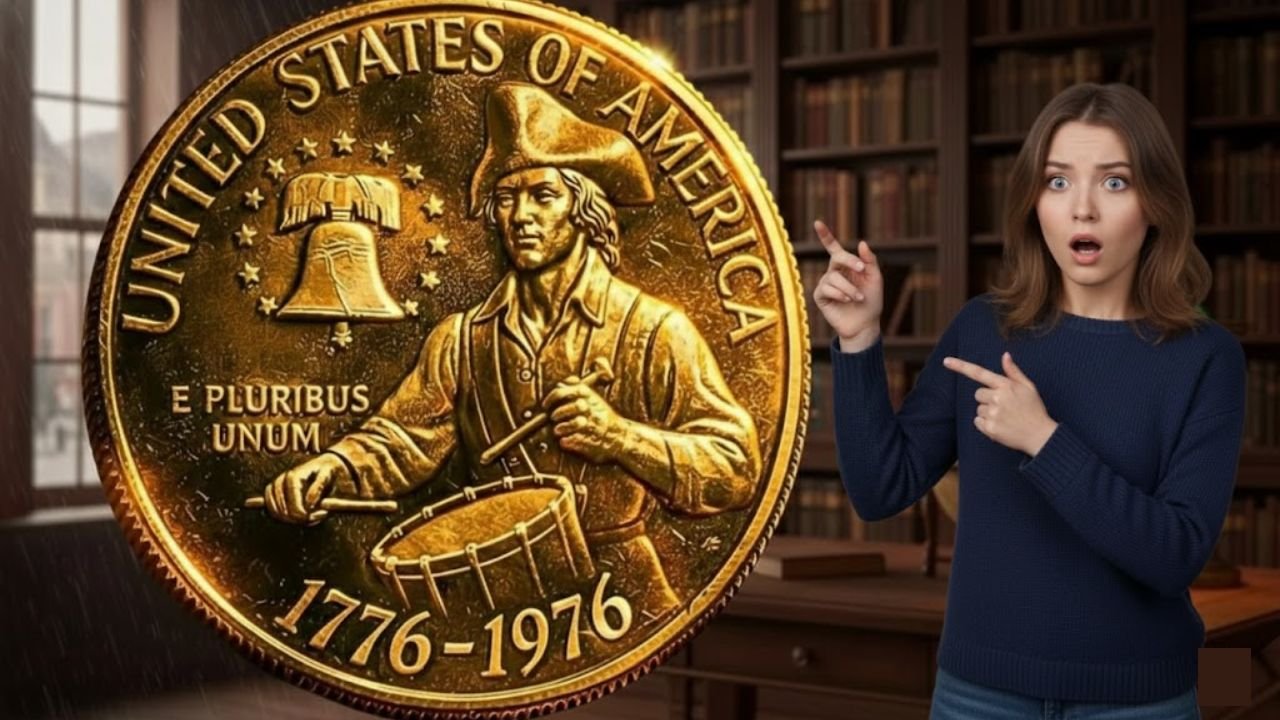
Rare 1776–1976 Bicentennial Quarter: Have you ever checked the change in your pocket? That ordinary-looking quarter with the drummer boy on the back might actually be worth way more than 25 cents. Let’s dive into the world of the 1776-1976 Bicentennial Quarter and find out what makes some of these coins secretly valuable.
A Coin Born from a Birthday Party
Back in the mid-1970s, America was getting ready to celebrate its 200th birthday. The US Mint wanted to do something special to mark the anniversary of the Declaration of Independence. So they decided to redesign the quarter, half dollar, and dollar coin for a limited time. The regular Washington quarter got a major glow-up. They kept George Washington’s face on the front, but added the special dates “1776-1976” underneath him. The real star was the back of the coin. Artist Jack L. Ahr created a cool design showing a colonial drummer boy with a victory torch and thirteen stars circling around him. Those stars represented the original thirteen colonies. These special quarters first showed up in 1975 and stuck around through 1976. People loved them! Everyone wanted to save one as a souvenir of the big celebration.
Bicentennial Quarter at a Glance
| Feature | What You Need to Know |
|---|---|
| Dates on Coin | 1776-1976 (all have both years) |
| Front Design | George Washington facing left |
| Back Design | Colonial drummer boy with torch and 13 stars |
| Regular Metal | Copper core with nickel coating (looks silvery) |
| Silver Version | 40% silver (made for collectors) |
| Mint Marks | No mark = Philadelphia, D = Denver, S = San Francisco |
| Face Value | 25 cents |
| Where to Find | Pocket change, old coin jars, bank rolls |
What Makes Some Quarters Worth Big Bucks?
Here’s the truth – most Bicentennial quarters are still just worth a quarter. But some can be worth serious money. Here’s what separates the common ones from the treasures:
- Silver vs. Regular: The 40% silver versions are worth more just for their metal. A silver quarter is worth around $5-7 even in worn condition.
- Mint Condition Matters: Coins that look fresh from the factory with zero scratches or wear can sell for $10-30.
- The “S” Mint Mark Magic: San Francisco made most of the silver collector versions. Find an “S” quarter and you might have something special.
- Error Coins Are Gold: This is where the real money hides! Mistakes during minting create rare coins that collectors go crazy for.
Collector Tips to Remember:
- Always check the edge of the coin – silver versions have no copper stripe
- Look at Washington’s ponytail for the tiny mint mark
- Grab a magnifying glass to spot doubling in the lettering
- Never clean old coins – it destroys their value
- Keep any quarter that looks weird or different from normal
Error Coins – The Real Hidden Treasure
The most valuable Bicentennial quarters aren’t the perfect ones – they’re the messed up ones! Mint errors happened when something went wrong during production. These mistakes turned ordinary quarters into collector dreams. Some error coins have sold for thousands of dollars. There’s a famous story about a doubled die error quarter where the lettering looks blurry or doubled. Another rare find is a quarter struck on the wrong type of metal, like a dime planchet. Imagine a quarter-sized coin that’s super thin because it was stamped on a dime blank! Off-center strikes are another cool error. The design gets smushed to one side leaving blank space. The more off-center and the more design showing, the more valuable it becomes.

Your Step-by-Step Guide to Checking Coins
Want to start hunting? Here’s how to check your change like a pro: First, look at the date. Make sure it says 1776-1976. Next, flip it over and check for the drummer boy design. Now peek near Washington’s ponytail on the front – is there a tiny D or S? Finally, look at the coin’s edge. A brown stripe means it’s regular metal. Solid silver color means you’ve found the good stuff! Remember that condition is everything. A beat-up silver quarter is still worth silver price, but a perfect regular quarter might only be worth a dollar or two. The real jackpot is finding an error coin in great shape.
Frequently Asked Questions
1. I found a Bicentennial quarter in my change. Am I rich?
Probably not yet! Most are common and worth exactly 25 cents. But check for mint marks, silver edge, or any weird errors. It takes two seconds and you never know!
2. What’s the easiest way to spot a silver quarter?
Look at the edge. Regular quarters have a visible brown copper stripe running through the middle. Silver quarters look solid silver all the way through. They also feel slightly heavier and sound different when you drop them.
3. How much is the most expensive Bicentennial quarter worth?
Error coins in perfect condition have sold for thousands. A super rare doubled die error graded MS-68 once sold for over $15,000 at auction. Not bad for 25 cents!
4. Should I take my coin to a coin shop?
If you think you found something special, go for it! Just call ahead and ask if they buy coins. Most shops will look at your find for free. Get multiple opinions if you’re not sure.
5. What does “proof” mean for these quarters?
Proof coins were specially made for collectors, not for spending. They have mirror-like shiny backgrounds and frosty designs. They come in special cases and are usually made with silver. You probably won’t find these in pocket change.
6. My quarter has a D mint mark. Is that good?
Denver made tons of Bicentennial quarters for circulation. A D mark on a regular worn coin doesn’t add much value. But if it’s in perfect condition or has an error, the D mark doesn’t hurt!
7. Where did all these quarters come from?
The mints in Philadelphia, Denver, and San Francisco cranked out over 1.6 billion Bicentennial quarters! That’s why they’re so common. The San Francisco ones are the rarest because most were sold in collector sets, not released into circulation.
8. Can I build a collection without spending much money?
Absolutely! Ask family members to check their old coin jars. Go to the bank and get rolls of quarters to search through. Trade duplicates with friends who collect. It’s a fun hobby that costs almost nothing to start.
The Bicentennial quarter is more than just money – it’s a little piece of American history hiding in plain sight. Every time you get change, take a quick look. That drummer boy might be waiting for you to notice him. Happy hunting!